 11
These big bats aren’t quite the behemoths they used to be.
With a leathery wingspan of up to a meter and a half, fruit bats —some of which are called flying foxes — feel a bit like they’ve flapped out of a fantasy novel. Though flying foxes include the world’s largest bats, one species in Madagascar appears to be shrinking, researchers report October 29 in the Journal of Mammalogy. Hunting pressure by humans may be why.
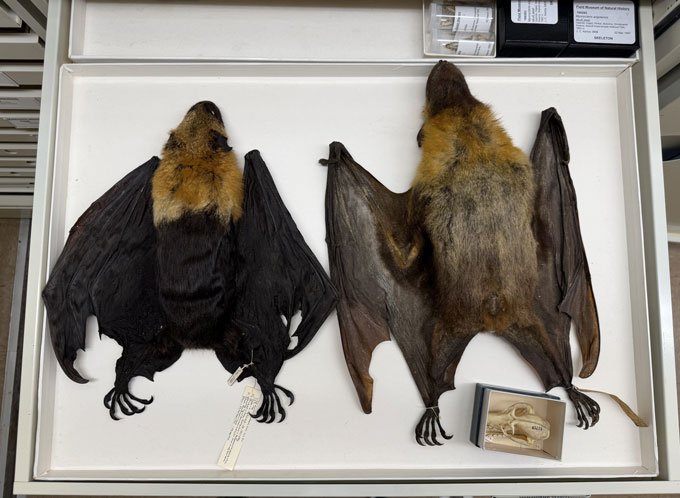
The first hints that the bats might be shrinking came from scientific collections at the Field Museum in Chicago. Researchers at the museum — including flying vertebrate ecologist Emily Cornelius Ruhs and conservation biologist Steven Goodman — noticed something strange about the preserved specimens of Malagasy flying foxes (Pteropus rufus).
“It seemed like the [flying foxes] in the collections were a lot larger than the ones that [field scientists] had been catching in recent years in Madagascar,” says Ruhs.
To see if newer specimens were indeed smaller than older specimens, and to understand why, the researchers began taking detailed measurements of the bats. The team logged measurements of 12 different features of the skull and teeth over a total of 121 specimens stored within nine museums. The specimens were collected over more than 150 years, up to the present day.
Bats collected prior to the 1980s had skulls that were on average 3.6 millimeters longer, or about 6 percent longer, than those collected after the 1980s. Possible causes of the shrinkage included effects from climate change or habitat loss. But the timing of the shrinkage also lined up with the commercialization of flying fox hunting.

Field Museum
“Bats are eaten in Madagascar in certain villages and cultures,” Ruhs says. Up until the 1980s, the animals were mostly hunted on a very small scale to provide food for a family or small community. But around that time, people started selling more bats at markets and restaurants.
As hunting pressure increased, the biggest bats in the population may have been selectively targeted since they provide the “most bang for your buck” Ruhs says.
The bats’ population has dwindled as well. There were an estimated 300,000 Malagasy flying foxes in Madagascar in the early 2000s. Researchers estimate the number has dropped two-thirds since then. The new findings raise concerns about how the bats’ shrinking bodies might be a bellwether for species-wide conservation risks. Future work on the bats’ genetics could tell researchers how modern populations are faring, Ruhs says. Other fruit bat species are also hunted and eaten in Madagascar, she notes, so seeing if similar shrinkage is happening in those species might be interesting.
“These are important food sources for people. But I think there is something to be said for understanding how to manage [their harvesting] a little bit more,” Ruhs says. “If this population isn’t doing so well, how do we overcome the needs of the people who live there while also protecting species?”